Alex Academy is here for one reason:
to help you speak and use English
naturally, fear-free.


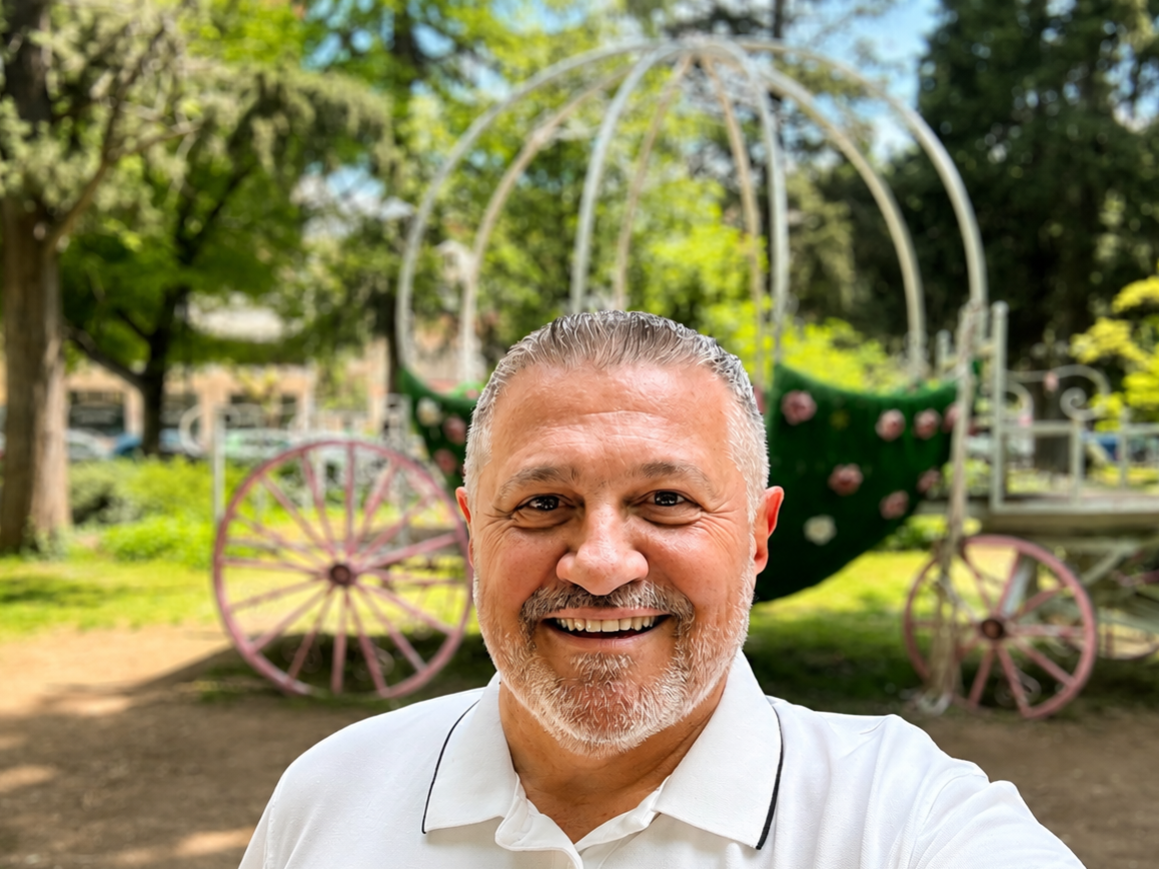
This is me.
When you've been teaching so long, and meeting so many people, you might be able to read people's minds too.
Can I try with you?
See if you find yourself in these questions — all of them came from my students.
And yes, you will read my mind too.
I tried courses and teachers. Why is my English still stuck and how to fix it?
Most people learn the school way. It is the only way they know. And the result is the same as school – you study for the test, and soon it's all gone. It's not your fault. It's the wrong method. I studied German like that. Now I understand some – but I can never use it. I never did the long practice, the kind that makes a language natural and automatic. And now it's not just rusty. It's almost gone.
I see the same thing with my students. One asked for a month off to study words alone because she didn't have the time. I knew what would happen. She came back exactly where she left – maybe a little worse.
Knowledge without practice disappears. Every time. That's the whole problem with the old method. It gives you knowledge. It never gives you the practice and the confidence to use it normally. And naturally. And that's exactly what I do differently.
→ Curious what natural learning actually looks like? → Take the 2-minute TEST to find out where to start
I understand English. So why does my mind go blank when I need to speak and how to deal with it?
There are many reasons for the blank. But the most common is perfectionism – you are afraid to make a mistake. What will people think of me? And that stress blocks what you already know.
That's what happened with my French. I still understand it, but I can't make a sentence. Because I know it's wrong – my grammar has almost disappeared, the words come too slowly. And I often find myself trying to translate.
It takes regular practice to fix it. I don't have the time to commit right now, and French is not my priority.
But if I need to activate it again, I know exactly what to do – and what it will take to make it active and useful.
→ Come practise with us – mistakes are allowed → Join the Free Confident English Club
Why do I always feel that I know nothing and how to change that?
That's what you were told – that you make mistakes, that you're not improving, that you have a lot to learn.
When I started learning English, I had a very strict teacher. She was never happy with what we said or did and always wanted more. She wanted us to be perfect. I'd go home and cry. I felt like an idiot. I was sure I wasn't improving – I was always making mistakes.
That summer, sitting on a beach, I couldn't even make one sentence in English. With thousands of words. But with zero confidence.
The next year, I had a different teacher. She gave us so much encouragement and was really happy when we were speaking and using the language. So I started improving by practising, and I was actually getting better, every class.
The way your teacher treats you shapes the way you see yourself in the language. That's why I always make sure I have a teacher, even if I study alone for a while – like I did with Italian.
→ Come find out you know more than you think → Join the free Live sessions to start speaking
Why do I translate every sentence in my head before I say it and how to stop?
That's the way you learned at school. Most teachers use grammar-translation. And it doesn't work well.
I'm a professional interpreter. I've interpreted for presidents, CEOs, politicians, live on TV, etc. Translation is for advanced learners – you need to know both languages very well, to translate meaning, not just words. That's why I have studied many languages, but I don't work with most of them. I don't know them well enough.
When you try to translate in your head, you get sentences slowly, and your head's full of confusion. Because a language isn't just words and grammar. It's culture, habits, traditions. Trying to translate early costs you everything. You lose yourself – not just your words.
→ Ready to stop translating and start using? → See LearnAbility Mastery
Why can I explain grammar better than I can actually use it and how to start using it naturally?
So many of my students ask me this. They learned grammar from books, and practised grammar in books but never learned how to make it personal. To talk about their day, family, work, or hobbies. So the grammar stays in the book. It stays inactive.
In real conversation, no one waits for you to tick every grammar box before you speak. But on paper, it feels completely different.
The same happened to me with Hebrew. I joined a university course. My teacher made it really academic – rules, tables, one after another, so many of them. I couldn't follow. I never learned to use the language in real conversation. Now, after a whole year of study, my Hebrew is close to zero. But I still know some of the grammar.
→ Turn the grammar you know into speech that flows → See the LIVE practice sessions
Why do people ask me to repeat myself, even when my sentence is correct? How to fix that?
I remember interpreting for USAID, for very high-level clients. I used the word "lubricant" many times in a part of the session. The native speaker I was interpreting for looked confused, lost. At some point I stopped and asked, "Is something wrong?" He looked at me and said, "I'm trying to follow – but what are you really talking about? What is this... lAbricant?"
I knew the word. I had just never checked how to say it. One wrong sound, and my client got a real headache. And couldn't follow.
So many students don't pay attention to pronunciation. But it matters. It can block real communication – even when every word you chose was correct.
→ Practise it out loud, every week → Join the free Live sessions
Why do native speakers sound like one long sound, with no words in it? How to understand them?
Native speakers are hard to understand – especially when they talk to each other.
I remember my first time in England, landing at Manchester airport. I picked up the phone to ask the customs officer if I had to declare my laptop. The woman on the line had her worst accent, and I almost dropped the phone. "Can you repeat, please?" I asked. She just coughed and kept going. I was desperate. I was an English teacher – and I didn't understand one single word.
Well – that is not quite true. Some time later in England, and some practice, my ear learned how locals really speak.
So that is the cure. You need practice. Sometimes a little. Sometimes a lot. Until your ear learns to catch both the words and the meaning.
→ Train your ear with real practice → See LearnAbility Mastery
Learn English by actually using it.
The natural and effective way we learn, like children learn their first language.
How to prepare effectively for the IELTS exam?
I have prepared many students for Cambridge exams – IELTS, FCE, CAE.
Often, they already know the language. What they don't know is the format. They haven't built the skills to work under pressure – and time is a huge stress factor in the exams.
Right now, I am preparing five students for IELTS. One is strict with herself, and she'll do great – I'm sure she'll score at least band 8.5.
Two others don't prepare so hard – their universities don't need very high bands, and they want to enjoy their last year at school. Surely their results will be lower.
The last two are working well, and I am sure they'll reach 7.5.
We don't just work on the language. We work on the right strategy – how to use the time well, how to skim, scan, make quick associations. I also use qualified colleagues and examiners in our classes – their tips, their real experience – and we bring that together with my students, until we find the strategy that fits them best.
And yes – most of them are surprised by their results. They get more than they expected.
→ Want a real strategy, not just more grammar? → See Private Coaching
Why don't I trust my own English enough to negotiate and I always bring someone else to talk or interpret? How can I do business in English?
Because you never practised in a safe place – where mistakes are OK, where you can express yourself, and where a teacher or a classmate can say, "Well done!"
That's why I built these safe rooms.
So many of my students are successful in their business – but don't feel successful in English. They feel insecure, because they believe English shows how good they are at their job. And if they make a mistake, they think it means they're bad at business too. That's a horrible lie.
Just listen to politicians on TV – many have strong accents, many make grammar mistakes. And yet, they lead countries.
Your English is a tool for your job. It isn't a measure of how good or how clever you are.
And yes – I graduated from a UK university, I've been teaching English for over 35 years, and I still make mistakes. Nobody's perfect!
→ Build the confidence to speak for yourself → See Business English Coaching
I have a lot of experience and really good ideas but I can't speak English and I don't get promoted. How to deal with this and move on in my career?
I have students who sweat before a presentation. They check the grammar in their head, again and again, building the perfect sentence. By the time it is ready – the conversation has already moved on.
You need practice. When you present to me, and to other students, again and again, you build the skills. And when you need to use English – it's there.
It is like cooking. A good cook can take a tin can and make something delicious, wherever they are. Someone who is not a cook thinks about the recipe for ages... and stays hungry.
And yes – I am a cook too. I went to cooking school. I worked as a cook in Sweden, in Czechia, in Bulgaria. A long time ago.
But yes, I can cook really well.
→ Get the words to match your ideas → See LearnAbility course
Can I actually talk with my grandchildren and not just smile and nod?
When people, aged 60 or older tell me, "Am I too old to learn?", I smile and say, "Depends on how you see yourself."
I had a student, 65 years old. She did an Elementary-level course, and later married an American – born and raised in the US. Age is never the problem, as long as she kept practising.
Right now, I have a student who is 72. She is really improving.
Another student, 68, called me because he travels a lot and doesn't want to look foolish any more. "Now's the time to fix my English too," he said. "I never had the time until now."
So yes – you can not just talk to your grandchildren. You can tell them bedtime stories too.
→ Start from where you are → See LearnAbility Foundations
Can learning English really help my memory and protect me from dementia?
I'm sure it can. There's a lot of research, and scientists recommend learning to keep our minds sharp.
I started learning Italian when I was 54. One of my reasons was exactly that – to help my mind stay sharp, and remember faster and better. And it worked really well.
That's why I'm learning Greek right now – training my own brain with it.
So why not try it yourself? I believe English can do the same for you – and you won't just have a sharper mind, you'll enjoy your trips even more too. Just like me.
→ Keep your mind sharp, one lesson at a time → Get the free eBook
I moved somewhere new, but I still feel like a visitor in my own life. How can I change that?
Years ago, in London, I met people who'd lived there for 7, even 10 years – and still only knew "Hello" and "My name is..."
They only talked with others who spoke their own language. They worked in kitchens, warehouses, fields, alongside other foreigners.
They told me how hard English was. I understood – they'd tried courses where every explanation was in English.
Yes, it's hard at the start. But it's a natural, normal way to learn. You just need help and encouragement along the way.
When I was in Sweden for an international course, I had no problem with English. But for a while, I shared a flat with an elderly couple. Very sweet, very kind people – but they didn't speak a word of English. I felt like a fool, talking only with my hands and smiling.
So I got a book. I started learning basic words. I made sentences with no grammar, no structure – just words. I knew I wasn't really speaking – I was just putting words together. But they were so happy, so encouraging. They gave me the correct sentence, and I repeated it, again and again. Slowly, I learned more.
In two weeks, I was speaking – very slowly, with many mistakes, but we were communicating. And that family was really happy. Because we were finally talking.
Fear will push you into a corner – everything looks strange, hard. Do the opposite. Go to the park, find an old man or woman with a dog, and start talking to them. The more you practise, the easier it gets. I know – I've done it with every language I've studied.
→ Start feeling at home in your new language → See LearnAbility courses
Why is it so hard at the beginning? How do I not quit?
Learning a new language is like arriving on a new continent. Nothing looks familiar. It's exciting – but when you try to describe what you see, the words aren't there. You try to compare new things to what you know. And they don't match.
You need time to feel at home in this new territory. And that's normal.
I'm struggling with Greek right now. I knew some Greek-based words from medical university – but here, they sound completely different. Slowly, I'm starting to make connections. But even the meaning is often different.
So I remind myself: this isn't my failure. My mind isn't weak, and it's not forgetting. It's simply a new continent, not just a new country – a different alphabet, a different structure.
The most important thing is my decision to learn the language. I decided not to quit in the first year – that's usually how long it takes me to start feeling a new language. And when I find a teacher, or a group to share my questions with, to practise with and use the language regularly, it gets much easier.
No one can motivate you if you've already decided you're no good. So I never let myself think that way.
I just keep telling myself: Greek babies learn it. Greek children speak it. Just keep going. It'll click soon.
Imagine not just enjoying the beach, but having a real conversation with the friendly Greek people around you. It'll be awesome!
→ Get the structure that keeps you going → Take the 2-minute Test to find where to start
How I've been helping
I wanted to become a doctor.
I thought that was the only way to help people – both my parents were doctors, very good ones.
I studied at Medical University for two semesters. Then I realised there're other ways to help – not just with physical pain and disease, but with the mind, the fears, the low self-esteem.
So I did my BSc in Social Management, then my MSc in Social Sciences. I saw many other ways to help people.
I started teaching English in 1989 – and I've been an interpreter since that same year. I didn't plan it at first. But when I tried it, I loved it.
For over 15 years, I ran my own language centre. I've taught office workers, managers, business owners, CEOs... and thousands of everyday people who simply wanted to speak with confidence.
I've interpreted for Mikhail Gorbachev, for presidents and ambassadors, for many businesses, and live on national TV.
I've studied 10 languages myself – some well, one or two not very successfully. I know exactly how it feels to be the beginner in the room.
My job isn't just to teach you grammar. It's to help you use the English you already have – without fear. To improve your self-esteem, and your freedom. Then your life and your career improve too. And your success makes me happy, and proud. It's happened with 2,800+ people. And counting.
Confidence begins the moment you start practising. And I'm right here to help you practise.
The goal is simple:
To help you speak English naturally, confidently, and without fear.
Not some day. Not after another course. Now.
You already have more English than you think. And you proved that by reading this page.
The next step is not learning more.
It is using what you already have.
And I can help you do exactly that.
 Alex Academy
